

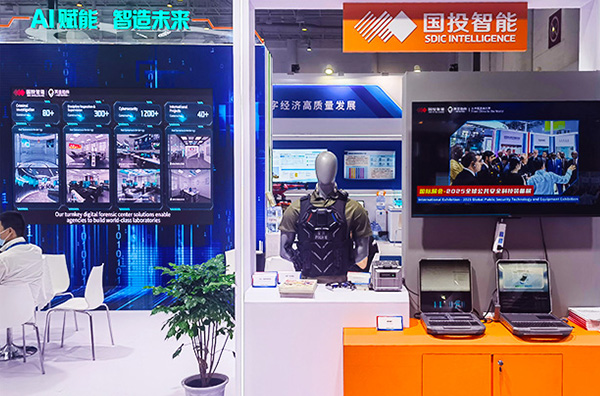
From May 27 to 29, the 2026 BRICS New Industrial Revolution Exhibition (hereinafter referred to as the "BRICS Exhibition") was grandly convened at the Xiamen International Conference & Exhibition Center. Guided by its "15th Five-Year Plan" strategic blueprint—specifically the "Stabilizing Two Fields, Expanding Three Arenas, and Optimizing One Service Pillar" framework—SDIC Intelligence Co., Ltd. (hereinafter referred to as "SDIC Intelligence") firmly capitalized on the developmental opportunities presented by the Belt and Road Initiative and BRICS cooperation. The company actively participated in the event, presenting a robust portfolio of leading international technological advancements at the Artificial Intelligence Pavilion within the Smart Factory Zone. During the exhibition, SDIC Intelligence featured a diverse array of flagship products meticulously engineered for overseas markets. These included the L4-class Smart Automated Mobile Forensic Cabin and the "Super Rubik's Cube" system. Furthermore, the company showcased its advanced smart security product suite, highlighted by the "Yuanzhi" Smart Earphones, "Yuanjian" Smart Glasses, and "Yuanjia" Digital Tactical Vests. Leveraging industry-leading technical capabilities, these innovations attracted significant attention from numerous international merchants and industry delegations, paving the way for in-depth professional exchanges and prospective business consultations. Closely aligned with the accelerating demand for intelligent transformation across the "Greater BRICS" markets, this year's exhibition introduced four dedicated core pavilions: Smart Factory, Smart Healthcare, Smart Agriculture, and Intelligent Mobility. The high-profile event successfully convened over 120 industry-leading enterprises from 10 nations, drawing more than 300 international buyers and 3,000 domestic trade professionals. The BRICS Exhibition continues to serve as a premier, high-level international platform for industrial collaboration, technical exchange, and economic partnerships among BRICS member states.
![[IDFC 2025] IDFC 2025 Successfully Concluded!](/uploadfile/news/84ca68e0db2847fd7552f09f4bc63cb7.png)
The 2nd International Digital Forensics Challenge (IDFC 2025) was successfully held from July 16 to 17 at the Marco Polo Hotel in Hong Kong. Jointly organized by Dataport Technology Limited, the University of Hong Kong (HKU), the Cyber Security and Technology Crime Bureau (CSTCB) of the Hong Kong Police Force, and the Hong Kong Information Security and Forensics Society (ISFS), the event aimed to strengthen global law enforcement capabilities in responding to digital forensics challenges. By simulating case scenarios, the competition provided a practical environment for participants to apply and exchange cutting-edge digital forensics technologies, tools, and methodologies—contributing to the advancement of digital forensics theory and practice. This year’s event attracted 27 registered teams from 20 countries and regions, with 22 teams from 15 countries and regions ultimately taking part. Participants included professionals from law enforcement, private enterprises, and academic institutions, with 10 teams representing Belt and Road countries and regions. The competition featured a simulated cybercrime scenario developed by CSTCB experts. It involved a sophisticated attack on an investment firm’s system, in which criminals tampered with the company’s artificial intelligence model to generate fake investment plans, luring unsuspecting investors into purchasing fraudulent cryptocurrency. This scenario reflected the emerging challenges that AI-driven criminal activities pose to the field of digital forensics. Participants were tasked with solving a series of forensic problems using a variety of tools and methodologies, ultimately working to reconstruct the case and uncover the truth. The challenge tested not only technical expertise and real-world investigative skills but also the importance of teamwork and strategic thinking. Following intense competition, the Hong Kong Customs and Excise Department (C&ED) claimed the championship in the Professional Law Enforcement Group, while the Department of Computer Science and Engineering (CSE) at the Hong Kong University of Science and Technology (HKUST) secured the top prize in the Non-Law Enforcement Group. The Independent Commission Against Corruption (ICAC) of Hong Kong, the Judiciary Police (PJ) of Macao, and the Korean National Police Agency (KNPA) of South Korea shared second place, with seven other teams earning third-place honors. In parallel with the competition, the Digital Forensics Technology Seminar was held, bringing together experts from the United Nations Office on Drugs and Crime (UNODC), INTERPOL, HKU, and Dataport Technology Limited. Discussions focused on the evolving role of digital forensics in combating cybercrime and the integration of AI technologies to strengthen investigative capabilities. Dataport Technology Limited is committed to driving innovation in digital forensics and delivering advanced solutions to law enforcement worldwide. Looking ahead, the company will continue...
![[IDFC 2025] The Digital Forensics Journey Begins!](/uploadfile/news/9b42b2760ec36c88bc60f107f25adadc.png)
With the rapid development of information technology, ranging from continual developments in traditional computing to emerging innovations such as the Internet of Things (IoT) and blockchain, law enforcement agencies are facing increasing challenges in the realms of digital investigation and forensic analysis. The International Digital Forensics Challenge (IDFC) aims to foster innovation, enhance participants' proficiency with the latest tools and methodologies in digital forensics, address emerging forensic challenges, and facilitate the growth of professional networks. Ultimately, the Challenge seeks to advance the capability of law enforcement agencies in digital forensics on a global scale. The challenge, designed by forensic experts from the Hong Kong Police Force, requires participants to analyze simulated real cases under strict time constraints. Using specialized forensic tools, participants are tasked with extracting, examining, and interpreting digital evidence from smartphones, computers, and other electronic devices to reconstruct events and uncover critical information. This hands-on approach not only enhances technical proficiency but also promotes international collaboration in combating modern cybercrime. The first IDFC, held on 19 and 20 November 2024 in Hong Kong, set a high benchmark for excellence. 10 teams from South Korea, Cambodia, Malaysia, Thailand, Uzbekistan, Indonesia, Vietnam, and three Hong Kong agencies participated in a competitive and intense event. Top honours were awarded to Hong Kong's ICAC, South Korea's 10VER3, and Cambodia's Cyber Task Force, in recognition of their outstanding analytical capabilities, technical proficiency and teamwork. Building on the success of last year's inaugural event, we are excited to announce the return of the IDFC in 2025. This year, IDFC 2025 will be held in conjunction with the 10th INTERPOL Digital Forensics Expert Group (DFEG) Meeting, bringing together global digital forensic experts in a dynamic and collaborative environment. We warmly welcome DFEG participants and forensic professionals worldwide to join us in this thrilling exploration of digital forensics, fostering innovation, professional growth, and international collaboration.

5月19日,由国投智能主办的2026年“智会”生态合作大会在福建省厦门市举行。本次大会以“智链生态,稳进拓远”为主题,以主论坛为牵引、多个专题分论坛为支撑,汇聚政产学研各方力量,搭建思想碰撞、资源链接、生态共建的高端平台。澜沧江—湄公河综合执法安全合作中心李大吴副秘书长出席并致开幕辞。 On May 19, the 2026 "Wisdom Summit" Ecosystem Cooperation Conference, hosted by SDIC Intelligence, was held in Xiamen, Fujian Province. The conference, themed "Smart Chain Ecosystem, Steady Progress and Long-Term Development," featured a main forum and multiple thematic sub-forums, bringing together representatives from government, industry, academia, and research institutions to build a high-level platform for intellectual 大会主论坛上,国投智能正式发布了“先锋战略计划”及升级版产品矩阵,展示了该企业在电子证据科学领域的创新突破。大会设立的五个专题分论坛,深入探讨人工智能在公共安全、取证合作、具身智能生态、海外生态合作等领域的创新发展。At the Main Forum of the conference, SDIC Intelligence officially released its "Pioneer Strategic Plan" and upgraded product matrix, showcasing the company's innovative breakthroughs in the field of electronic evidence science. The conference featured five thematic sub-forums, exploring in-depth applications of artificial intelligence in areas such as public security, forensics business cooperation, embodied intelligent ecosystem and overseas ecosystem cooperation and development.In his opening address, DSG Mr. Davuth LY noted that the rapid iteration of artificial intelligence has continuously upgraded the tactics of emerging transnational crimes such as telecom fraud and cybercrime, making it urgent to strengthen law enforcement cooperation and public-private partnerships. He highly commended and expressed sincere gratitude to SDIC Intelligence for its professional support in organizing digital forensics training programs for law enforcement officials from the five Mekong countries, and proposed three initiatives: strengthening joint capacity building, deepening practical technological cooperation, and constructing a regional security ecosystem.
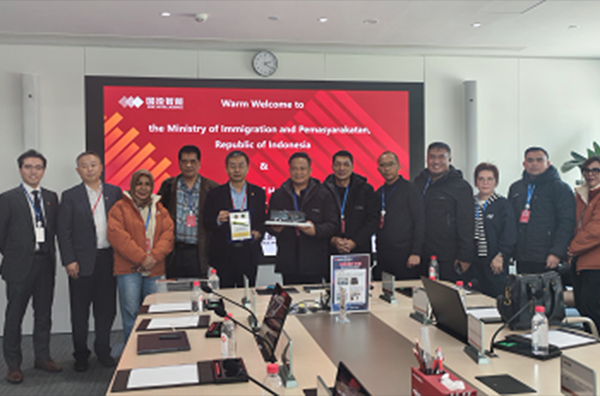
On March 7, a delegation from Indonesia’s Ministry of Law and Human Rights (Immigration & Corrections) and General Inspectorate of the Ministry of Home Affairs visited SDIC Intelligence. Mr. Zhao Yong, Chief Strategy Officer and Head of International Business, and Mr. Gong Bo, Deputy General Manager of Xindehui, accompanied the visit. The delegation toured exhibition areas covering digital forensics, cyber security, AI large models, and open-source intelligence, and spoke highly of the technologies and their practical applications. During the symposium, both sides held in-depth discussions on digital forensics, security prevention and control, and intelligent policing systems. Indonesia expressed strong willingness to cooperate with SDIC Intelligence on localized implementation, aiming to upgrade intelligent policing equipment, enhance digital forensics capabilities, and improve crime-fighting efficiency. SDIC Intelligence stated its readiness to deepen practical cooperation and support Indonesia’s security system upgrading. The visit further consolidated China-Indonesia cooperation in digital security. Indonesia sincerely invited SDIC Intelligence to conduct field research and in-person coordination, with both parties planning to expand joint projects to boost regional security and stability.
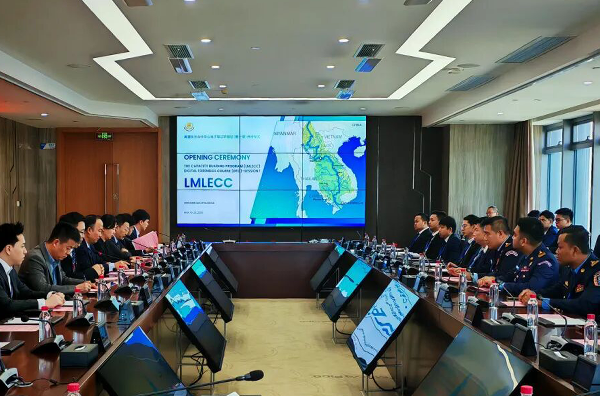
To deepen law enforcement and security cooperation in the Lancang-Mekong region and jointly enhance the capacity to address emerging criminal challenges, LMLECC holds the series of Digital Forensics Courses in Xiamen, China. The series, comprising five consecutive sessions, is hosted by SDIC Intelligence Information Technology Co., Ltd. and targets professional law enforcement personnel from Cambodia, Laos, Myanmar, Thailand, and Vietnam. On March 17, the LMLECC Digital Forensics Course Session 1 officially kicked-off. Deputy Secretary-General Mr. Ly Davuth of LMLECC attended the opening ceremony and delivered a speech. Twenty law enforcement officers from the Ministry of Interior and the National Information Technology Center of Cambodia participated in this session.


